Showing posts with label cabin construction. Show all posts

Wednesday, September 5, 2012

The Hundred Year Roof


Good news!  The roof didn't collapse under the weight of 20,000 pounds (9072 kg) of slate!  

Of course we still have to see what happens when the first snow falls!

If everything holds up, this roof should last at least 100 years.  I have personally seen slate roofs in England, and Italy that have been in operation for even longer than that.

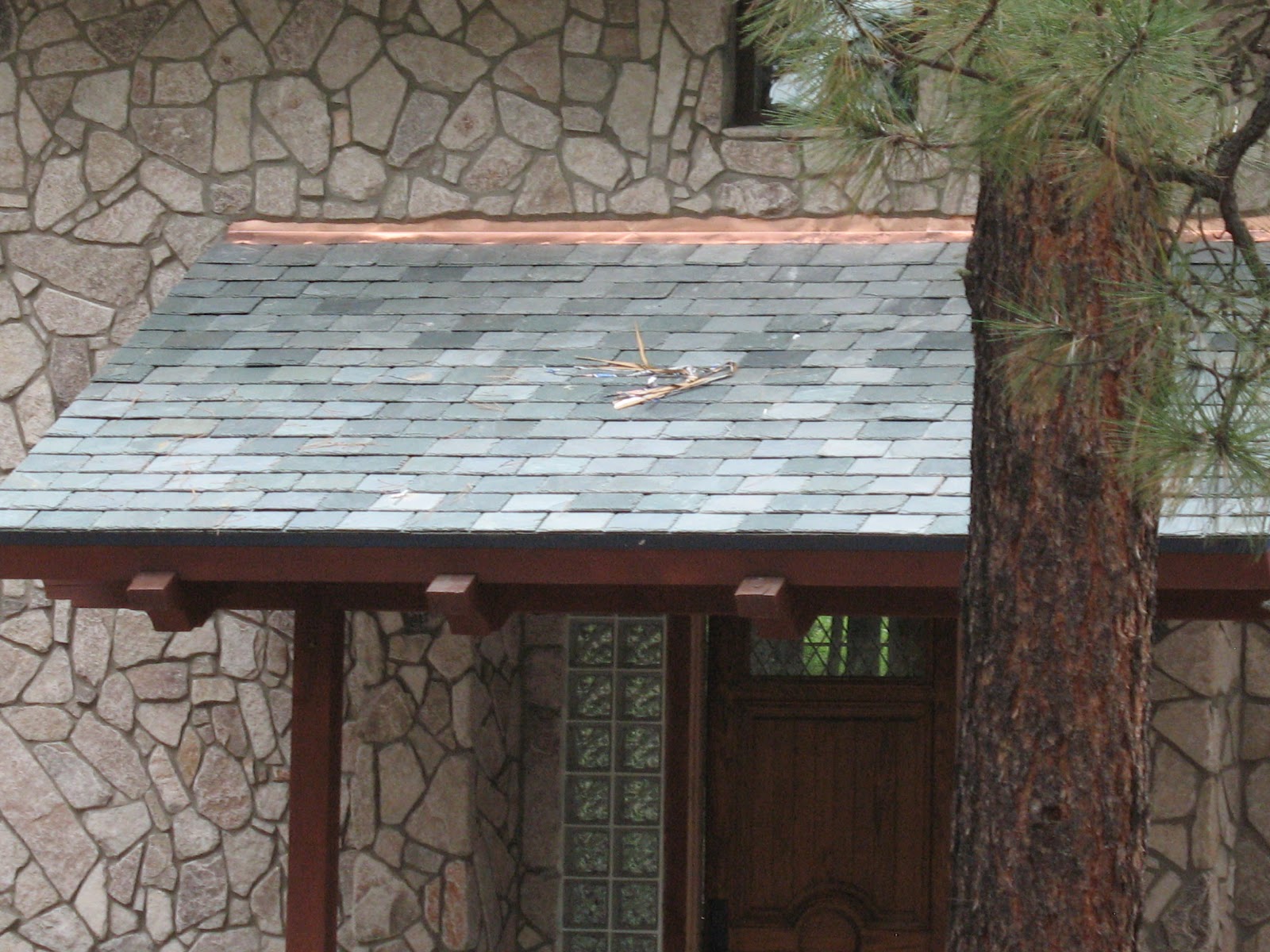
The slate is from China, and is nominally 10 mm thick, thicker than typical American slate that you see sometime in the Eastern U.S. The color is called Forest Green.  We used copper flashing and copper nails, at the urging of the roofer, since it holds up the longest and resists corrosion better that other materials.

There are actually four roof sections, the main roof and smaller roof sections over the dining room pop-out, the front porch, and the balcony.  Here are some pictures:


Ronnie Sensiba holding a roof slate in the left hand and a floor slate in the right hand.


The front porch roof.


Note copper in the valleys where the main roof and dormers come together.


Front door with porch.


Roof over dining room pop-out


Shining in the rain
You may be thinking it's crazy to spend that much money on a roof; however, if you consider the cost over the entire life-span of the roof, slate is actually more economical in the long run.   

I hope that's true.  I'll be very disappointed if this roof doesn't last 100 years!

Saturday, May 12, 2012

We Love You , Bank

The Bank Comes Through!

I found an interesting article on MSN Money that explains why the mortgage lending system is broken and I think I understand why so many people are having trouble getting mortgage loans.  The article is at MSN (http://realestate.msn.com/article.aspx?cp-documentid=33371952#scptih)
At any rate, after contacts and negotiations with 3 banks and one private lender (Don Salvatore made me an offer I just had to refuse) ; after over 700 pages of documents were faxed, scanned, copied, emailed, or just mailed; after 14 months of trying, we finally have a construction loan!!  Amazingly, it is a 3.25% ARM mortgage, one-time-close,  so we are in business.  Yeah!!

Most of the work recently has been behind the scenes,  ordering windows, rock, slate,  fireplaces, gearing up for a major push in the coming weeks.

We do have some solid progress to report in the plumbing,  however.

Remember the Chinese Delta ripoff shower valves?  Here they are in a proper installation. 


Notice the use of PEX (cross-linked polyethylene) tubing, which connects with the copper pipe.  The PEX tubing will not crack when it freezes, but the copper pipe will, so you have to make sure the water drains down and away from the valve.

Here's the shower valves in an improper installation:

Notice here the water does not drain away from the shower valve and will cause the valve and pipes to burst when they freeze.


The vertical pipes going up from the valve on either side will have air pockets to prevent banging or knocking sounds in the pipes.

Our water heater will be a propane tankless water heater, which is more energy-efficient since it only heats the water on-demand, rather than keeping a tank full of water heated at all times.


All is ready for installation of a tankless water heater.

Luckily, we only need one vent stack going through the roof.  Each pipe penetrating the roof means more opportunity for leaks, and damage from snow sliding.


This is going to be Napoleon gas insert fireplace.  Right now it's just a framed hole with a propane line running to it.


We're hoping the pace of construction accelerates, now that we actually have a construction loan and can order the materials that we need and pay all the many different tradesmen and subcontractors.


Sunday, April 1, 2012

Spring at Last

Spring has sprung
The grass has riz
I wonder where
The flowers is.

The last of the snow is melting around the cabin, uncovering all the things that got lost under the snow during the winter.  The contractor was wandering around the new cabin yesterday and found a tool that he has lost a few months ago and hadn't been able to find.

Working in brutally cold conditions, braving ice and snow, the crews managed to essentially complete the interior framing and the small roof sections and overhangs for the front entryway, the dining room pop-out and the balcony.  It's really taking shape!  We can now see the final outline of what the finished cabin should look like.

Here are some pictures:


                                                            Front Entry

                                                   The balcony (il balcone).
                                                  The Dining Room Pop-out.

                                                         The Big Window.
Actually, when we realized that the views in and out of the big window were quite limited due to the elevator shaft and stairway, we decided that the bottom half of the big window will be glass block, and the top half will be a big window.

Now that we have good weather, we are ready to make a big push, and try to get as much done as possible, before the rainy season starts.  We'll keep you posted!

Monday, January 9, 2012

Lighting It Up

Getting ready to put up the roof trusses


Most of us never pay any attention to lighting fixtures.  As long as a light comes on when we flick a switch, we don't care where that light came from, as long as it's bright enough for us to see.
Designing and planning a new house, however,  forces us to think about light.  When you start to pick your light fixtures things suddenly get very complex.  I know a little about light.  From my exposure to photography (pardon the pun) as a hobby since  I was in my  teens,  I know about direct light, indirect light, and diffuse light.  I know about color temperature, e.g., incandescent light vs florescent light vs daylight, and how that is described in degrees Kelvin.  From Human Physiology and physics, I know about light intensity as measures in lumens, and contrast.
Nowadays we can light our houses with incandescent bulbs, florescents, halogen lights, and, most recently, LED lights.
There are myriad light fixtures to choose from: recessed lights, flush, semi-flush, pendants, track lights,  spots, floods, sconces, table lamps, torchieres, and chandeliers.


This is the ceiling of a chapel illustrating four different types of lighting: pendant lamps, recessed can lights, indirect lighting and spot-lights.


There are dimmers.  There are remote controls and programs to control lighting.
Then there is style or theme.  There's Art Deco, Contemporary/Modern, Rustic, Cabela's, Victorian, Asian, and on and on.
There's even medical considerations.  Many migraine sufferers cannot tolerate florescent lights.  As we get older, our retinas are less sensitive, so we need more light to be able to see. 
Personally, I like to have more than one choice in lighting in any one area.  To my wife's great chagrin, when I remodeled a bedroom in our old cabin, I put in 4 light circuits: 1 for recessed lights, 1 for ceiling fixtures, 1 for track lights, and a spot above the bed for reading. Overkill?  Maybe.  But in our kitchen in Tucson, I can turn on recessed mini-floods on a dimmer, or a wraparound florescent fixture and the room looks completely different depending on which lights are on.
I estimate we will have about 42 different lighting fixtures in the new cabin, and for each we have to make decisions.  I want to have a modern/contemporary look for the inside of the cabin.
Here's an exercise:
The loft will have a high ceiling with exposed beams, trusses and wood paneling.  It is about 20 X 20 feet.  I have to guess what it will look like since the roof isn't actually up yet.  Here's what I think it will look like looking up at the ceiling.


I was going to put 4 pendant lamps hanging from the ceiling to get the light source closer to the living area.  However, the nice lady at the lighting store suggested 4 double floods, mounted on the sloping ceiling, and directed downward.  I balked at first, thinking it was going to be too hard to change the bulbs when they burn out.  I've seen too many older persons come into the hospital with broken hips or worse, from falling while trying to change a light bulb. 

For Pendants:  Pro's  Lights closer to the floor.  Con's  Draw attention away from heavy wooden trusses and logs which are supposed to be the visual focal point of the room.  Space too cluttered with 4 pendants and 2 ceiling fans.

For Floods:   Pro's  Don't draw attention away from heavy wooden trusses and logs.  More open space.  Con's   Lights are hidden among strucures in the ceiling.  Direct lighting, casts harsh shadows.  Hard to change bulbs. 


Then I had an inspiration.  I found a new LED PAR 30 flood rated at 60 watts which actually consumes 15 watts.  It costs $35 at Home Depot.  However, it saves $285 over the life of the bulb!  It lasts 50,000 hours!!  That's longer than I am going to be alive.  I will never have to change the bulb!  Eureka! That's the solution.  Now I just have to come up with an extra $1000 in the budget for light bulbs.

Bonus Photos!:


Maybe I should call this the Mud-blog